
Meeting Strange Dangers
What makes people heed or ignore expert warnings?

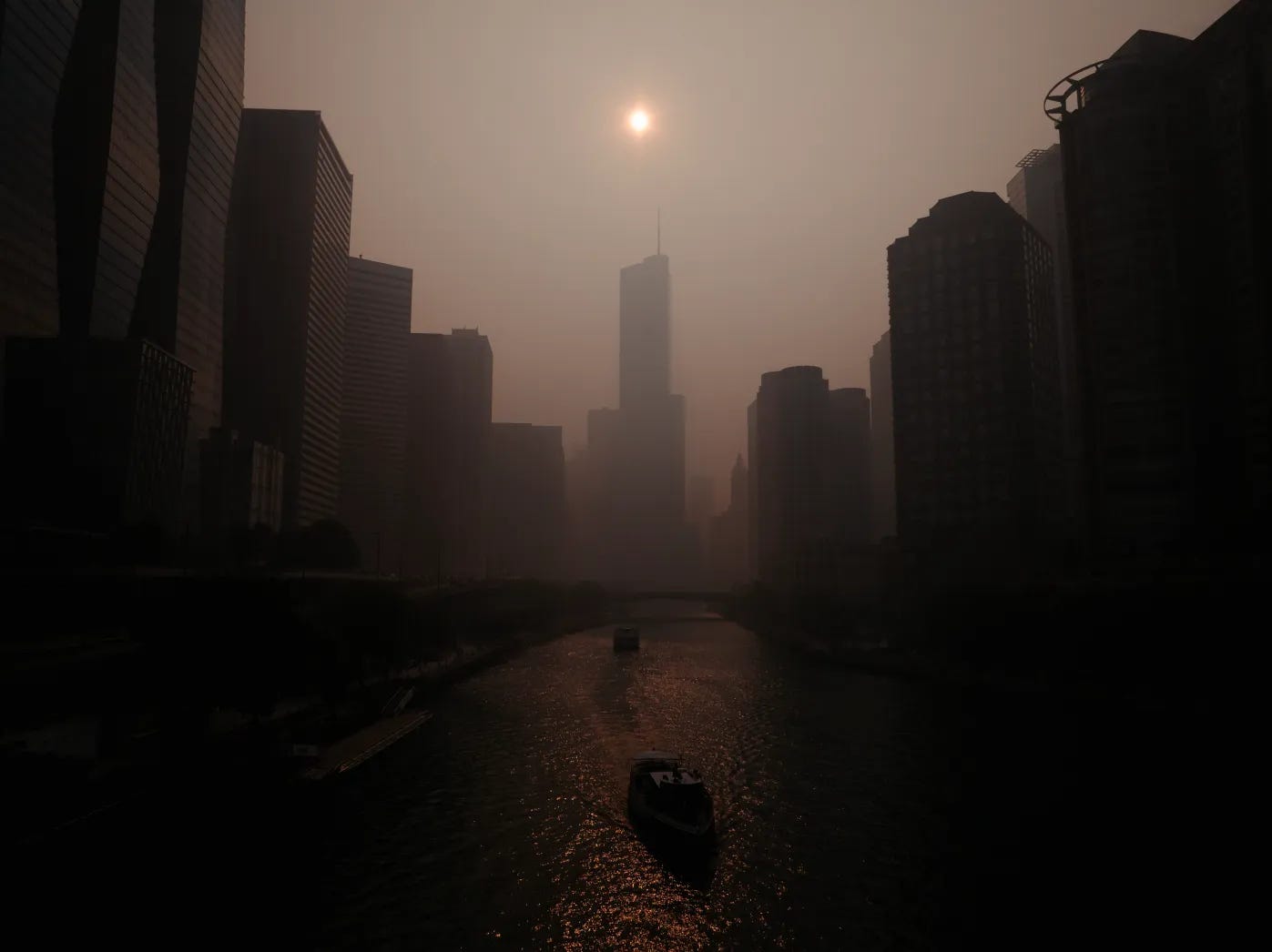
This July, for the second time since 2023, smoke from unusually intense Canadian wildfires darkened the skies over much of eastern North America. At one point, Chicago had the worst air quality in the world, and towns and cities from the Great Lakes to the Northeastern U.S. broke records for air pollution.
The return of wildfire smoke is worrisome for two reasons.
First, it’s a sign that what was an unprecedented hazard in 2023 is becoming a recurring one. Global warming is producing hotter, drier summers in Canadian forests, which is leading to more and larger wildfires (for a deeper explanation, see this excellent post by climatologist Zeke Hausfather). These fires are often set off by lightning in remote areas and, because they are so remote, are largely impossible to contain and extinguish. Over the coming years, summer in the U.S. will be marked by, in addition to heat waves and intense storms, dayslong stretches where fine soot from northern fires makes it unhealthy to breathe outdoors.
The second worrisome thing is just how unhealthy this soot turns out to be. Robinson Meyer points to new research suggesting that the economic burden of wildfire smoke-related deaths in the U.S. exceeds the cost of climate-related damage from all other causes.
The thing is, most of us just don’t realize how harmful this kind of smoke is. It’s a new danger. We have little direct experience to draw on here. You step outside one day under an orange sky, your eyes water a little and your throat stings, with no obvious explanation. No fire is burning nearby, and at ground level it doesn’t look like you’re enveloped in smoke. The damage accumulates anyway, exposure after exposure. Journalist Colleen Hagerty has a very useful roundup of the health science involved, in her newsletter. But the most interesting part of her roundup, to me, is this snippet from her interview with atmospheric scientist Joseph L. Wilkins about how hard it is to get people take the danger seriously:
A lot of times you can’t see air quality. You can’t see air pollution. You just don’t know. That’s why we rely on the instrumentation to tell us what it is, and we rely on these model predictions and these tools so we can tell you exactly at your location what the actual air quality is, and then you can respond.
You know, I’m not a social scientist by any stretch, so we need to get those folks in the room more. We also need to get the constituents in the room, the actual people, and ask them, ‘What would make you take [smoke] more seriously?’ Because I can scream till the cows come home and tell you this is bad, it’s going to take off years of your life—we can calculate exactly how many years of your life it’ll take off depending on how much you breathe. We know all this stuff, and it’s a matter of how do you get the people to believe it? How do you get people to respond to it?
Wilkins’ concern here — how do we get people to believe us scientists? how do we get them to act on our warnings? — is a strong contender for The Refrain of Our Times. Why didn’t people listen to the science during Covid? About Climate Change? About vaccines? About drinking raw milk? In sociology we often refer to this as The Crisis of Expertise, a generalized collapse in the public legitimacy of expert knowledge. The reasons for declining trust in experts are complicated and varied. It’s hard to “just follow the science” when scientific knowledge is provisional, makes claims that are difficult for lay people to evaluate, and because usually the application of scientific knowledge involves making political or moral choices with tradeoffs that can’t be adjudicated through the scientific method.
But there may be some answers to Wilkins’ specific question, of how to get people to believe scientists about future dangers and respond to the warnings, in the sociology of social activism. Sociologist Kate Pride Brown, in a study of environmental activists in Russia, points out that most people take their social world as a given, something they can’t influence. Most of us believe things are the way they are because of “human nature,” or because of divine will, or because of the inertia of power. When it comes to ideas about the future, there is, she writes, “a variable degree of fatalism and freedom in the public mind for imagining alternatives and the means by which to achieve them.”
For change to happen, Brown writes, some people have to believe that social activism has some plausible route to success. She calls this belief the prospectus for social activism. A person’s prospectus is influenced by their inhabited experience — the things that actually happen to them in everyday life; their inherited experience — their understanding of historical experience in their community; and their circulated experience — stories they encounter about life and history outside their local experience.
I think you can apply this model pretty straightforwardly to people’s imagination of disaster. Call it a prospectus for disaster. There are plenty of people who believe it’s futile to prepare for or try to prevent future disasters (I wrote about this in a recent issue of this newsletter). There are others who think it’s hubris, or blasphemy.
For some, inhabited experience teaches that misfortune arrives regardless of anyone's best efforts, so preparing is a waste of time. For others, it teaches that bad things happen mainly to other people, who somehow bring it on themselves and can’t or shouldn’t be helped. For others, conversely, preparation and discipline have paid dividends in daily life — or at any rate they believe they have — and they seek out knowledge and resources to continue that practice. Inherited experience works the same way: people take what they’ve been told about how their families and communities endured past disasters as a guide to perceiving and meeting future dangers.
One trouble with disasters is that they’re rare. Most of what we know about them arrives circulated from elsewhere. Our knowledge comes transposed from different settings, different kinds of dangers that we try to map on to whatever we’re currently facing or fearing. To know about strange dangers we have to reach outside our direct experience, drawing from institutionalized knowledge like expert advice and public policy, but also from culture — films and TV and internet memes, books and poems, religious traditions, folktales and urban legends.
Where we get our knowledge about future dangers, and what to do about them, is a habituated choice, an outgrowth of all of our previous choices and experiences. As sociologist Jessi Streib argues, we opt in to or out of certain cultural systems based on the conditions we experience over our life course. Maybe you opt in to a belief in the value of hard work in education because you had success early on, had teachers or family who encouraged you to go to college and supported you along the way. Then again, maybe a lack of support or resources, along with encouragement towards achievement outside education, convinces you to opt out of schooling and be suspicious of academics. Maybe a string of bad experiences with doctors convinces you to opt out of the system of medical authority. Maybe regular experiences with indifferent or condescending bureaucrats convinces you to opt out of belief in the efficacy of government assistance.
Our disposition towards perceiving future danger and acting on it is also shaped by our circulated experience. Stories in our culture present us with tools we can pick up to help us interpret the world and make our decisions in it. A newly published study of German folklore and voting patterns in the 1930 Reichstag elections shows, through a particularly grim case, the power of circulated experience to shape people’s perception of threats and their responses to them. Examining archives of Kinderschreck — folktales told to teach children about certain kinds of danger, for example, “do not go to the cornfield or the werewolf will take you” — the researchers find that regions whose stories featured more “ethnic bogeymen” in the fairy tales circulating in their population showed stronger electoral support for nativist, authoritarian parties running on xenophobic platforms. The relationship was strongest in regions that under economic or political stress. In other words, hardship met a cultural toolkit stocked with stories about dangerous outsiders, people were more likely to blame their troubles on ethnic others, and to vote for politicians who promised to rid them of those bogeymen.
Of course, stories can also inspire us to heed our better angels, to overcome our fatalism about the possibility of saving our world and each other regardless of our differences. But circulated experience will only get you so far, once it mingles with the realities of people’s inhabited and inherited experience. A society where trust generally is falling as people live more isolated social lives under conditions of widening economic inequality, where everything feels like a scam and they’re confronted on social media with a flood of cheap but emotionally resonant cynicism, is not a society that primes people to pay attention to AQI warnings and take collective action to rein in greenhouse gas emissions.
But trust can be rebuilt, and communities can rediscover the real benefits of collective action. It’s hard work, but history is full of examples of our past successes. The first step is believing change is possible. The second is reaching out to others to make it happen.