
Sequelae
On Minneapolis and the afterlives of crises

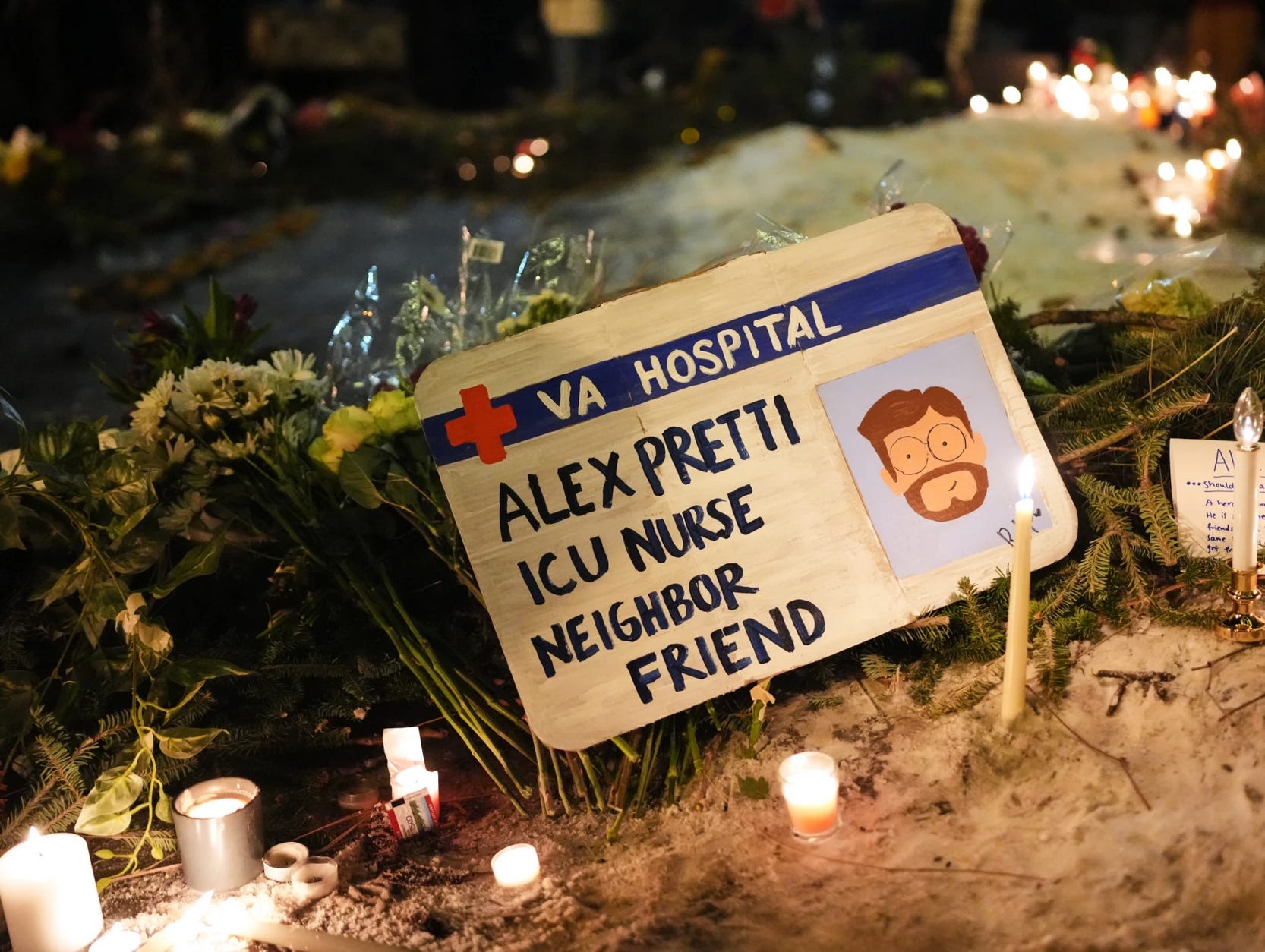
Yesterday federal agents in Minneapolis pinned an ICU nurse to the street and shot him apparently 10 times at close range, killing him. The city hadn’t yet recovered from the events of the previous week, when another federal agent shot a young mother through the head as she attempted to drive away from a squad of immigration agents. The Department of Justice’s treatment of the earlier shooting was so egregiously irregular and immoral that it prompted the resignations of six federal prosecutors in Minnesota and an FBI agent in the bureau’s Minneapolis field office.
The killings fit a pattern of misconduct by immigration agents, detailed in a ruling by a federal district court judge earlier this month, that one legal scholar said recalled “the civil rights movement in the South and how Southern law enforcement reacted with hoses, dogs and lynchings.” A former General Counsel of the Department of Homeland Security, who served under the first Trump administration, posted a statement to social media last night saying he was “enraged and embarrassed by DHS’s lawlessness, fascism, and cruelty.”
Beyond the deaths and the clashes with protesters and legal observers, national media haven’t quite figured out how to describe the breadth and depth of the pall the federal government has cast over the Twin Cities. Minneapolis’ Emergency Management Director said on Saturday her city felt like the conflict zones abroad where she’d previously worked, where for ordinary residents “daily life is very difficult, where it’s hard decisions constantly, such as ‘am I safe to go to the grocery store? Am I safe to take my kids to school? Am I safe to go to the doctor?’”
Being a U.S. citizen doesn’t provide concrete relief from these questions — roving immigration agents routinely harass citizens, often using significant force to detain and interrogate anyone from high school students to Target employees to off-duty cops. People disappear off of the streets. It is not uncommon now to find abandoned cars in the roadways, sometimes with their engines still running, left behind by smash-and-grab immigration stops. People disappear from their houses, as when agents forced their way into the home of an elderly Hmong-American man in St. Paul last week, without a warrant, led him into the street at gunpoint and held him for hours before accepting that he was a citizen and releasing him.
The perception of intense racial profiling motivating these stops and detentions has left many residents of color, in particular, in fear of leaving their homes, regardless of their citizenship status. In St. Paul’s public school district, 1 in 4 students from Spanish-speaking households have missed every day of school since the federal immigration surge began in December of 2025, and attendance among Somali students has dropped as well. Businesses in the Twin Cities are struggling financially as workers and customers vanish, avoiding the risks of public excursions.
The widespread fear, disruption, and isolation, the empty businesses and classrooms, bring to mind the lockdowns of the early weeks of the Covid pandemic.
I have been thinking a lot about ICU nurses and the trauma of the pandemic lately. I read a recent book by sociologist Jason Rodriquez, On the Frontlines of Crisis, about the experiences of intensive care unit workers during the pandemic — I reviewed it for the journal Social Forces. The expressions of fundamental insecurity I’ve heard from people in the Twin Cities, the searching for past experiences to make familiar the disorienting dislocations of the present, match the social crisis responses I documented in my research on how people sought to ground themselves amid the first wave of Covid in 2020.
As Rodriquez describes it, the core of the Covid crisis was this: in the early pandemic ICU workers, whose entire identities are anchored in their skill in saving the most gravely ill and injured people using validated procedures, protocols, and instruments, were confronted every day with their nearly universal helplessness to save the patients they received suffering from a novel virus that didn’t follow any rules they knew. When they did save someone, it seemed to have been by luck, rather than anything they as medical professionals did. They saw more Covid deaths than anyone, and most of what they saw around them was death. They were hemmed in by safety rules that isolated them from coworkers and even, in many ways, from their patients. When a patient died, these ICU workers were often the only other person in the room, usually holding up a tablet or smartphone overhearing loved ones say anguished final goodbyes by video call. This went on for months. For their efforts, ICU workers were sometimes mocked as overcautious around the virus — told that Covid wasn’t that dangerous, that masking in public was superfluous. Sometimes doctors and nurses were told that, actually, they were the ones making people sick. Rodriquez quotes a travel nurse who treated patients dying of Covid who had been told the disease didn’t really exist and believed it, and would lash out telling their care workers “you guys are doing this to me.”
I wonder about the long-term effects of that, of a generation of people whose vocational calling was to care for and heal the sick, who found that they couldn’t, and ended up seeing themselves despised by whole segments of the public in spite of or because of their work. I was thinking about that when I found out that Alex Pretti, who was tackled to the ground and shot to death as he was coming to the aid of someone being shoved and maced by federal agents, had worked in a Veterans Affairs hospital ICU. Thought about it while I was watching this video of Pretti giving the final salute to a veteran who had passed away. Thought about it while reading DHS officials make claims about Pretti’s actions and motives that are obviously contradicted by the video recordings of his killing.
At the same time I have to admit I’m thinking about the cloistered world of the thousands of people now working — or soon to work — as immigration agents, or as guards in sprawling detention centers. Thousands of people whose vocation will have them, maybe every day for months on end, alternately pepper spraying and tear gassing, detaining, shackling, and fatally shooting people; being despised and insulted by the public and degraded in private by their political overseers for failing to meet their quotas. I wonder about how those experiences will systematically shape these people, how it will color their perception of the world for the rest of their lives, and how those effects will reverberate through society for years to come.
On a brighter note, I’m thinking about the volunteer response networks now being activated in Minneapolis, the seeds of which were sown during the pandemic and the protests that followed George Floyd’s killing by police. This pattern fits recent research from another context, which found that Danish adults who volunteered to help during the Covid pandemic were far likelier to volunteer again to aid Ukrainian refugees who arrived in the country fleeing the Russian invasion. It is encouraging to see that, in fact, crises can build and strengthen social connections and make communities more capable of managing future stresses.
These communities will suffer lingering harms of course too, that will long outlive this moment; the families that have been broken up by immigration raids, the people who will bear emotional and physical scars from brutal treatment at the hands of masked federal agents or in the internment camps currently being constructed. Learning losses for students who have had to hide at home from their government. Dreams deferred. Lasting grief. Gnawing distrust.
It will only become clear later to what unexpected places this current moment will lead. As the late sociologist Kai Erikson wrote, “trajectories do not come to an end until they turn into obituaries.” Erikson was writing about the course of his own life, at the time. But the trajectory of a person’s life often continues after the obituaries are written. A life accumulates new meanings as it is carried forward in the memories and actions of the people who honor it and are inspired by it. In this way some good can come from even the darkest moments in a changeful world.